Most corporate software initiatives die quietly inside a clean-room fallacy: the belief that an operational business can be accurately captured in an air-conditioned boardroom over a series of polite Zoom interviews.
In the traditional model, high-priced advisory firms deliver polished slide decks and 18-month transformation roadmaps that no engineering team can realistically execute. When handed off to conventional software agencies, the failure compounds: the agency asks the client to write an exhaustive 50-page functional requirements spec, retreats for six months, and writes code strictly to the tickets—regardless of whether that logic survives contact with reality.
Six months and hundreds of thousands of dollars later, the software arrives. Management organizes mandatory training and declares victory.
Within three weeks, the system is dead.
The software doesn’t crash. The test suites pass, the CI/CD pipeline is green, and the relational schema is theoretically normalized. But on the dispatch floor, in the warehouse bays, and across the loading docks, the real work has retreated to where it has always been: sticky notes stuck to monitor bezels, frantic WhatsApp groups, paper carbon dockets, and rogue Excel spreadsheets maintained by two indispensable coordinators who know how the business actually runs.
The failure of operational software is rarely a failure of technology. It is a failure of proximity and empathy.
Where the Spec Breaks Down
Operations in distribution, haulage, commercial manufacturing, and field services do not fail because staff are technophobic. They fail because operational environments are governed by compounding exceptions that no specification author in an office ever anticipates:
- A driver calls at 5:45 AM because a trailer coupling is jammed, detonating a three-drop delivery sequence across congested routes.
- A tier-one customer insists on being billed per pallet tier rather than gross weight—a bespoke handshake arrangement agreed over lunch seven years ago that appears in no manual.
- A supplier unloads eighteen mixed pallets when the purchase order specified twelve standard crates, forcing a dock clerk to decide in ninety seconds whether to turn the lorry away or conjure yard space out of thin air.
Generic enterprise SaaS and remote-built applications treat these critical operational compromises as "user errors" or "invalid states." They force the operator to stop what they are doing, click through multi-step modal dialogs, fill out five mandatory input fields, submit an escalation ticket, and wait for supervisory approval.
On an active operations floor, where physical assets are moving and every minute of detention burns real margin, people cannot wait for software that refuses to acknowledge reality.
When software fights reality, reality always wins. The team simply routes around the tool to keep the trucks rolling.
The Origin of Forward Deployed Engineering (FDE)
To solve problems where software must survive severe, messy, and mission-critical conditions, industry pioneers had to invent an entirely different operating model.
The philosophy of Forward Deployed Engineering (FDE) was forged by companies like Palantir and later adopted by teams deploying complex AI systems into unpredictable enterprise environments, such as OpenAI. When Palantir deployed software into defense operations, disaster response hubs, major financial institutions, and global supply chain choke points, remote development was a non-starter. There were no 40-page requirement specs. If the software failed to handle a disrupted satellite uplink, an improvised field asset, or corrupted incoming telemetry, operations failed catastrophically.
The solution was radical: take elite software architects and systems engineers out of the tech office and embed them directly on the frontline alongside the operators.
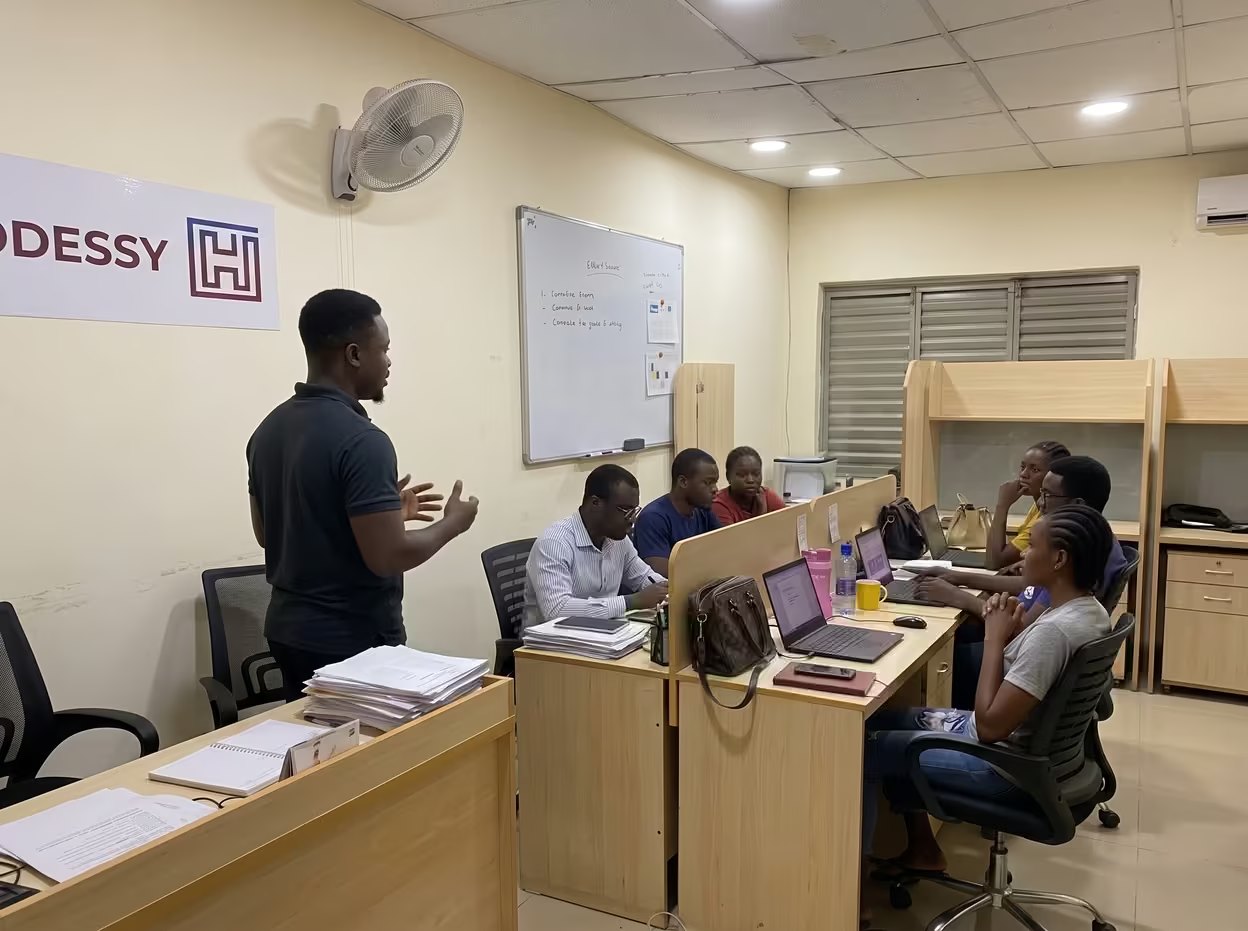
At Hodessy, we discarded the traditional consulting and offshore agency playbook to bring Forward Deployed Engineering to commercial operations.
The Reality of the Floor: Why Edge Cases Are the Core Product
True operational logic does not live in an executive handbook. It lives in the edge cases—in the muscle memory and split-second decisions of the people who keep the business standing.
You cannot discover why a yard manager overrides a routing engine during a 30-minute video call. You only understand it when an engineer stands beside them at 6:00 AM in the freezing rain, watching them balance two phone lines while negotiating yard bottlenecks.
Embedding senior engineers on the floor fundamentally alters how systems are architected:
1. High-Stress, Low-Latency Ergonomics
When an engineer watches an operator work under pressure, they instantly realize why multi-level dropdowns, slow spinner states, and confirmation modals kill adoption. The interface must be built for rapid keyboard navigation, dense information displays, near-zero latency, and instant state recovery.
2. Exceptions as First-Class Citizens
Traditional software treats exceptions as errors to be blocked. Forward deployed systems treat exceptions as standard operating procedure. Splitting a consignment mid-transit, adjusting a spot fuel surcharge on the fly, or logging a provisional receipt must take three keystrokes, not an administrative escalation.
3. Rapid Field Iteration Loops
Instead of disappearing for quarters to deliver a massive "big bang" rollout, FDEs deploy vertical slices in days. An operator uses a new pricing or dispatch module on Tuesday morning; the engineer sits beside them, notes where they hesitate, refines the codebase that evening, and ships the update before shift change on Wednesday.
The Ultimate Metric: Outcome vs. Output
Traditional agencies bill for output:
- "We completed 42 Jira user stories."
- "Sprint 4 was delivered on budget."
- "We handed over 120 pages of documentation."
These are vanity metrics. A project can hit 100% of its technical deliverables and still deliver zero commercial value if the floor refuses to touch it.
Forward Deployed Engineering measures itself exclusively on operational outcomes:
- Do the ledgers balance down to the exact cent without manual reconciliation?
- Do the foremen and dispatchers actively rely on the tool to get through their shift?
- Has the shadow spreadsheet been permanently discarded?
Software succeeds on the operations floor only when it respects the speed, chaos, and nuances of the physical world. Forward Deployed Engineering does not ask your business to contort its hard-won competitive advantage to match a standardized software template—it builds the software around the reality of your floor, engineered to last and owned entirely by you.