The Strangler Fig on the Warehouse Floor: How to Replace Legacy Plumbing Without Stopping the Line
If you want to witness pure executive dread, walk into the office of a Chief Operating Officer running a twenty-million-dollar haulage depot, a regional distribution network, or a multi-branch field contracting firm, and say the following phrase:
“It’s time for a system cutover.”
The room instantly cools down.
Every operational leader carries the scar tissue of a catastrophic enterprise migration. They have lived through the standard consulting playbook: an eighteen-month, multi-million-dollar replatforming project that promises a sparkling new digital future. A small army of enterprise advisors spends nine months drawing workflow diagrams in air-conditioned conference rooms. Timelines slip. Scope balloons.
Then comes the fabled “Big Bang Weekend.”
The plan sounds so tidy in the slide deck: on Friday at 6:00 PM, the legacy software will be shut down. Over thirty-six hours, scripts will pump millions of historic records into the brand-new platform. On Monday morning at 6:00 AM, the workforce will log in, sip coffee, and operate happily ever after.
By 7:15 AM on Monday, reality detonates.
The new system’s validation rules choke on real-world exceptions. Gate clerks cannot clear trucks because a mandatory tax identifier wasn’t backfilled. Yard coordinators cannot override an axle-weight discrepancy. Dispatches stall, phones ring off the hook, detention fees accumulate by the hour, and by Wednesday afternoon, the operations manager makes an emergency call to resurrect the old database.
Six months of momentum evaporates. The company retreats to its fragile spreadsheets, and leadership vows never to touch the core technology again.
The fundamental error was not the code. The error was the belief that an operational business can hold its breath.
You cannot pull the plug on an operating system when trucks are rolling, pallets are moving, and customer invoices must leave the door. If you want to replace legacy plumbing, you have to learn how civil engineers replace a suspension bridge: one steel cable at a time, while highway traffic is still roaring across the deck.
The Anatomy of the Big Bang Fallacy
Why do traditional all-at-once cutovers fail on the operations floor with near-mathematical certainty?
Because operational software is not a static catalog or a marketing brochure; it is a live metabolic organ. A legacy system that has run a warehouse, a fleet, or a contracting group for a decade is encrusted with hundreds of invisible edge cases, silent tribal compromises, and unwritten operational habits:
- The twenty-year commercial customer who receives a split-consignment discount that exists in no official policy guide.
- The field depot that loses 4G connectivity every afternoon at 3:00 PM, forcing coordinators to batch physical gate tickets on paper before syncing.
- The supplier whose invoicing system always submits quantities in gross pounds while your ERP measures in net metric tons.
When an enterprise agency attempts an all-at-once migration, they try to specify all of these edge cases upfront in an abstract 200-page functional requirements document.
It is structurally impossible. The only complete documentation of your operational business is the legacy system itself—bugs, workarounds, spreadsheets, and all.
When you force a clean cutover on a single Monday morning, you are placing an existential bet that your software team discovered 100% of the operational realities your company accumulated over ten years. When they turn out to have captured only 85%, the missing 15% halts the business.
The Strangler Fig Pattern: Nature’s Engineering Manual
In the rainforests of Queensland, Australia, the Ficus watkinsiana—the Strangler Fig—pulls off one of nature’s most sophisticated architectural takeovers.

It does not chop down the host tree.
A seed germinates high in the upper branches. It drops slender, flexible aerial roots down toward the soil. Slowly, quietly, it taps into the forest floor, drawing nutrients and establishing its own independent root base. Over years, it weaves a dense lattice around the host trunk. It replaces the structural work of the original tree branch by branch, limb by limb.
By the time the host tree rots away inside, the strangler fig is already an enormous, self-supporting pillar standing completely on its own.
The forest canopy was never leveled. The shade was never interrupted.
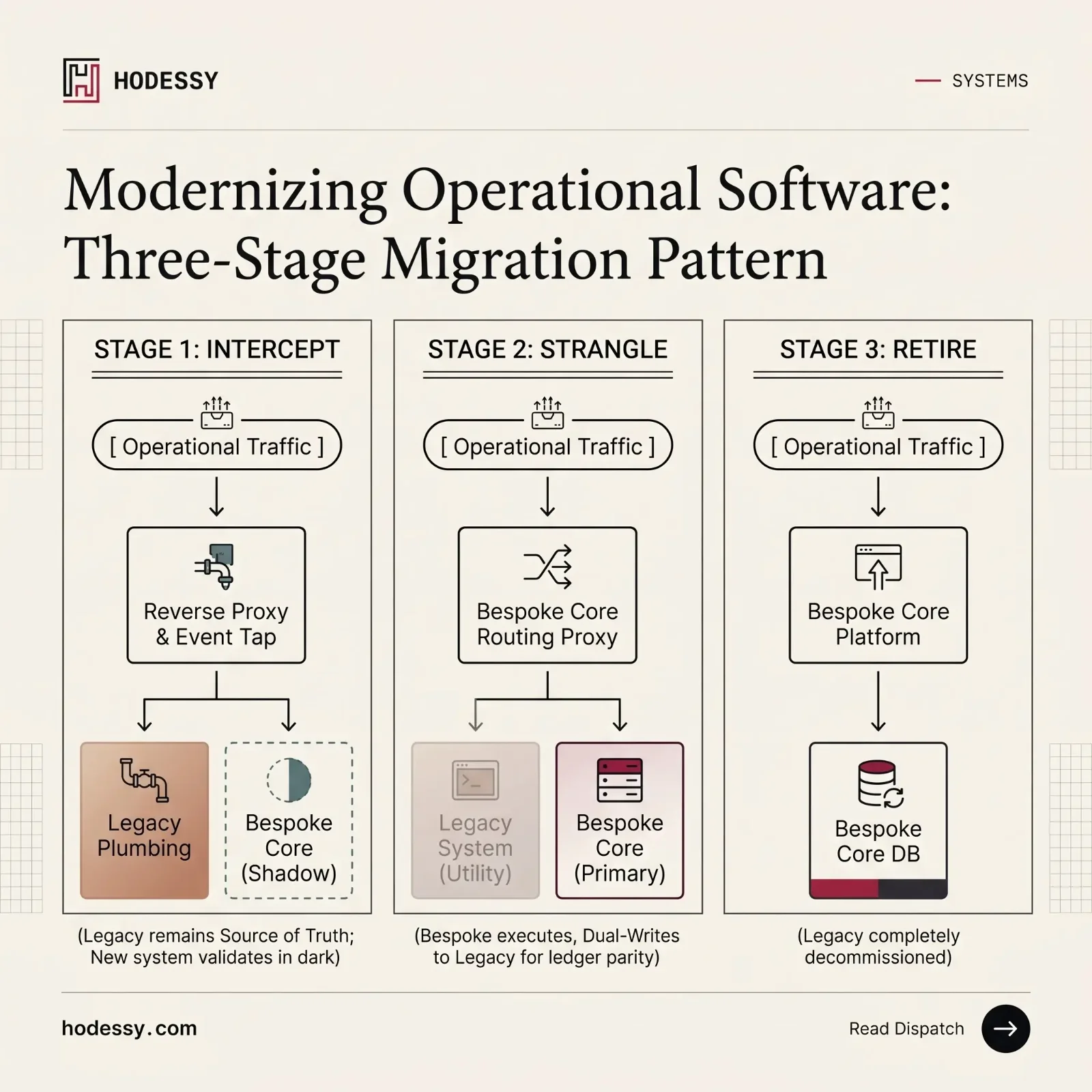
In software engineering, applying the Strangler Fig pattern means gradually replacing legacy components by routing traffic around specific operational slices until the legacy software is entirely surrounded, emptied, and quietly decommissioned.
On the warehouse and dispatch floor, this is not an academic microservices theory. It is the only safe, repeatable way to modernize mission-critical operations without risking customer deliveries or stopping the line.
The Forward Deployed Playbook: A 4-Step Zero-Downtime Migration
Forward Deployed Engineering approaches migration not as an IT deadline, but as a continuous engineering bridge. Here is the exact architectural blueprint for modernizing live operational plumbing.
Step 1: The Invisible Event Tap (Listen Before You Speak)
Before writing a single customer-facing screen, place an unobtrusive event listener on the boundary of your legacy environment.
Don't ask the legacy software to change. Simply set up automated webhooks, database transaction logs (Change Data Capture / CDC), or secure background pollers that quietly observe production events:
- Every time a quote is approved.
- Every time a driver scans a barcode.
- Every time a billing clerk modifies a line item.
These payloads are mirrored into the new Bespoke Operating Core.
At this stage, the new software has zero write authority. It operates completely in the dark. It receives live operational reality and runs its state machines, parsing real-world inputs against normalized relational schemas. If an edge case causes a schema failure, no driver is stuck at the gate, no customer is delayed, and no ledger is corrupted. The engineer simply inspects the payload, updates the state constraints, and hardens the model.
Don't guess what reality looks like from an interview; let your live data stream teach the new engine every nuance of your business.
Step 2: Carve Out the Most Painful Vertical Slice
Never attempt to replace the entire system at once. You do not swap the engine, the transmission, the brakes, and the tires simultaneously on a moving van.
Pick the single operational loop that causes the most human agony, errors, or delays:
- The three hours dispatchers spend manually assigning multi-drop delivery manifests.
- The messy intake verification of driver proof-of-delivery photos and waybill receipts.
- The custom volumetric pricing recalculation that finance struggles to reconcile at month-end.
Build a tight, high-performance, keyboard-first tool specifically for that isolated slice.
When the operator uses this new interface, they don’t feel like they are embarking on a massive corporate transformation. They are simply using a fast, purpose-built screen that does one miserable job effortlessly in fifteen seconds instead of forty minutes.
Step 3: Dual-Write and Cryptographic Parity Verification
This is the engineering safeguard that eliminates cutover terror.
When the operator takes an action inside the new slice—for example, recalculating and approving a complex multi-tier invoice—the new operating core does not simply update its own database. It performs an idempotent dual-write:
- It writes the authoritative state to its own database.
- It immediately transforms the payload and pushes it back into the legacy ERP or accounting tool via native API or background transaction.
For weeks, the legacy system continues to believe it is running the show. The company’s historical general ledger remains completely intact.
Meanwhile, behind the scenes, automated verification gates run daily reconciliation audits:
- Did the total tax, discount, and unit pricing calculated by the bespoke core match the legacy ledger down to the exact cent?
- If a discrepancy of $0.04 appears, why? Did the legacy system run an unrounded floating-point calculation, or did the new rules miss a legacy regional surcharge?
You do not switch off legacy infrastructure on faith; you switch it off on mathematical proof. You run dual-write until the legacy system has produced zero variance for thirty consecutive days.
Step 4: The Hollow Shell Decommission
Once a slice operates with verified 100% parity, the flow reverses: the new Bespoke Core becomes the unquestioned Source of Truth for that workflow, and the legacy tool is reduced to a passive downstream archive.
Then, you take the next slice:
- Fleet dispatch is migrated.
- Yard intake is migrated.
- Exception billing is migrated.
Tab by tab, screen by screen, the legacy software is emptied out from within. Its sprawling menus and slow forms become ghost towns because the team is doing all their real work inside snappy, keyboard-first screens built for their exact operational pulse.
One Friday afternoon, you turn off the legacy server.
There is no champagne ceremony, no all-hands crisis team eating cold pizza in the boardroom, and no Monday morning panic. The host tree has simply rotted away, and the new trunk has been bearing the full load of the business for months.
The Two Rules of Operational Continuity
If an agency or software vendor pitches you on replacing your core operating software, test their engineering discipline with two non-negotiable rules:
Rule 1: The "Five-Minute Rollback" Guarantee
If a software deployment requires more than five minutes to safely revert to the previous operational state, it is an irresponsible architecture.
On the operations floor, an outage cannot wait for an emergency sprint or a hotfix commit. If a new gate inspection screen stumbles on a novel batch of foreign shipping labels, the operator must have a single-click fallback to the legacy workflow. Your software must be designed with feature flags and reverse synchronization so that dropping back to the old method is instantaneous, painless, and loses zero transactional state.
Rule 2: Legacy Systems Are Innocent Until Proven Guilty
Bad software agencies blame the legacy system for everything. They want to tear it down because reading someone else’s old database schema is tedious, unglamorous work.
A disciplined forward-deployed engineer respects legacy plumbing. That clunky, twenty-year-old on-premise system or that weathered accounting database has survived because it successfully processed hundreds of millions of dollars of real business transactions. It represents the durable survival of your company.
Your goal is not to punish the legacy software; your goal is to unburden it. You let the legacy ledger handle what it does well—commodity general bookkeeping and statutory accounting—while surgically extracting the fast, chaotic 30% where your operational margin actually lives.
How to Start Without Halting the Floor
You do not need an eight-figure IT budget or a two-year transformation roadmap to escape the software trap.
Modern engineering allows you to begin small, fast, and safe:
- Map the shadow work: Find the three spreadsheets that your operations coordinators open before they touch the official ERP.
- Listen to the event stream: Stand up a read-only event listener to mirror your daily transaction volume into a clean modern database foundation.
- Deploy a single vertical slice: Build one dedicated, high-speed interface for your single worst operational bottleneck—and prove dual-write parity within four weeks.
The fear of modernization is rational; the fear of cutover failure is well-earned. But staying frozen inside rigid SaaS templates and fragile spreadsheets is a slow, compounding tax on your margin and your enterprise valuation.
Stop waiting for a quiet operational window that will never arrive. Build your strangler fig, plant the roots under the floor, and replace your digital plumbing while the water is still running.